
Insulation Strategies
There are many possible options for insulation. This section gives the pros and cons of each material and advice for best practices on installation.
Note: It is important to inspect the air sealing before the walls are closed. This allows any issues to be identified and corrected while the walls are still open. Repairs are much more difficult if the home fails the blower door test after final inspection when the walls are already closed.
NYBTG recommends the use of spray foam as insulation because of its superior air sealing capability.
However, because of its cost, it is not practical for every application.
If you are using batt insulation alone, there are several areas that require extreme attention to detail when airsealing, and a few situations where fiberglass can never be used alone.
Spray Foam
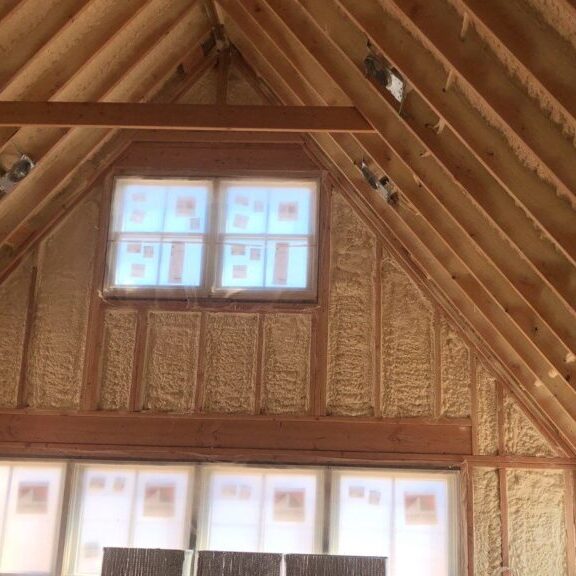
Spray polyurethane foam (SPF) insulation is an advanced, energy-efficient, and air sealant capable product. There are a few product options available depending upon the intended application.
- Closed Cell – A hard, vapor-resistant foam that may be used to airseal a home.
- Open Cell – Offers the same insulation benefits as closed cell foam but does not act as a vapor retarder or barrier.
ATTICS: It is becoming common to create a “sealed attic” using spray foam insulation in the rafters rather than in the ceiling.
Fiberglass Batts
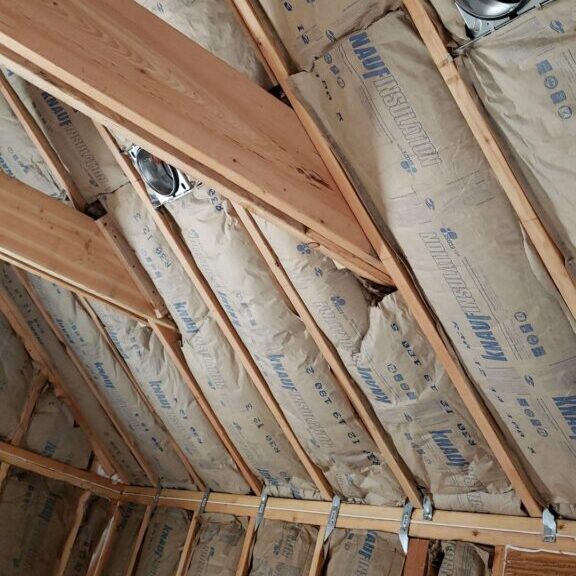
Batt insulation is one of the most common and cost-effective insulating methods. It provides basic coverage in homes in floor, wall, and attic cavities. It is a quick, affordable, and sound dampening option.
We have run into situations where builders have insulated both the ceiling and the rafters in an effort to keep HVAC equipment “inside conditioned space”. Again, unless the roof assembly is insulated, properly vented, and air-sealed, it will not meet NYS code and will likely have serious moisture and mold issues.
Flash & Batt
Why not both?
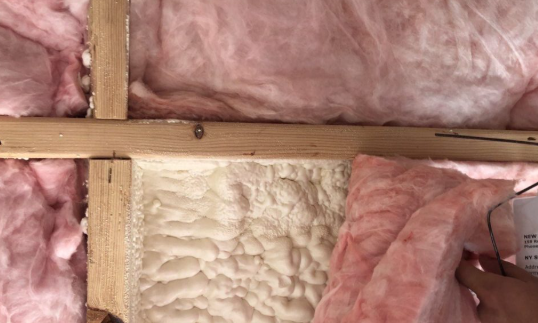
The combination of high density spray foam used within cavities first followed by batt insulation is becoming a more popular method for insulating a wall assembly.
Batt insulation added in following the spray foam layer increases cost savings for the project to meet wall assembly R-value requirements for code compliance.
A minimum of two to three inches of high density spray foam allows the cavity to become air sealed while doubling as a vapor retarder.